Uncategorized: biennio flauto jazz Conservatorio di Ferrara conservatorio flauto jazz corso estivo in flauto jazz diploma in flauto jazz ethno-jazz geoff warren Geoff Warren Quartet jazz jazz education jazz flute Jazz flute music jazz flute summer school La Côte Flûte Festival LAUREA IN FLAUTO JAZZ MatRecords Online lessons triennio flauto jazz TUTU Records yamaha
by admin

leave a comment
Six Pieces for Flute and Piano
Here is the latest chapter in my online autobiography. To read the whole story click on the link above left.
Six Pieces for Flute and Piano
As mentioned in a previous chapter, these pieces were written around the turn of the century and were my first efforts at writing for flute and piano using a computer programme, Encore3-0.
The late ‘90s for me were a period of intense individual instrumental teaching in the private sector. I had a good number of saxophone and flute students, mostly adults, and mostly between beginner and intermediate levels.
I always tried to teach in a room with a keyboard, having realised that having the harmony and some sort of rhythmic accompaniment helped the student understand better what he was playing. And in the private sector the important thing was to keep the students interested, since they paid by the month, not by the year. So that little moment of actual music making often made the difference.
At a certain point, as well as using the extensive repertoire of A4 sheets I had assembled, each with a few lines of melody and perhaps some chord symbols written over the lines, I wanted to go a little further and create some pieces of my own, and specifically for flute and piano.
My habit of accompanying my students from the keyboard during lessons had helped me develop my rather basic keyboard skills to the point where I could now write credible if somewhat simplistic piano accompaniments. Since the piano was there to accompany the flute, and these pieces were intended for students, a lack protagonism on the part of the pianist wasn’t going to be a problem.
The process was guided by my coming to terms with the technology of the time. I soon found I could write the music in Encore, convert to midi file and then, by means of a floppy disc, get the keyboard in my classroom to play back the track. Gradually I was freeing myself from the limits of my plodding accompaniment style for the piano and could write more interesting parts – even physically unplayable parts if I wanted, which I usually didn’t.
Most of the melodies came initially from my doodling at the flute, but one of them actually grew out of the piano part. This was Mimosa, the first piece of the series to be written, and I remember constructing the basic two-bar piano figure first.
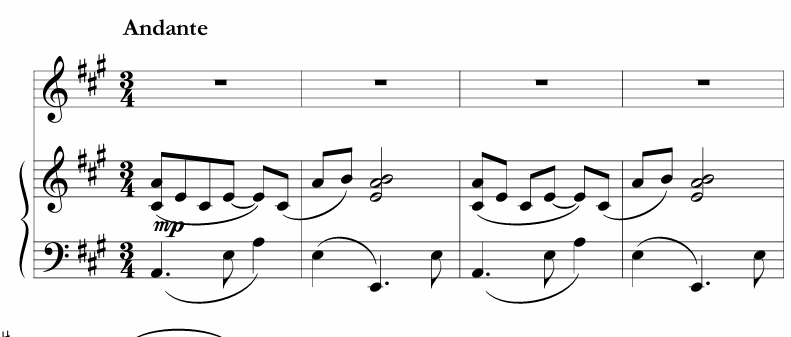
The slight rhythmic ambiguity of this motif, inspired the melody line which many students have found difficult to count at first sight.
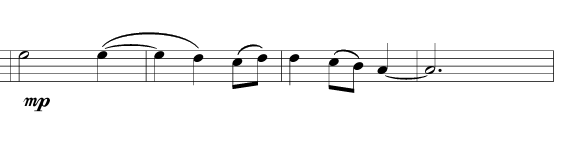
I kept the pieces short enough to be approachable, and printable on two pages, so with a normal music stand no page turning was needed. The average time is just under two minutes; slightly shorter than a “single” but longer than an advert, and the length is just about enough to give a feeling of direction, of something happening, and of working to a finish. There is a basic form to each piece.
One thing I notice when playing though these pieces is my obsession with the note E2.
In 2000 I bought my Powell; flute number four in my life. This had a really full and satisfying E2 and I just kept coming back to that note, which funnily enough is often considered a “problem note” for flautists.
Just look at the opening melody of “Waterfalls:

On finishing the pieces, I asked the M.A.T school in Verona for whom I was teaching if they could do a sort of in-house edition so copies could be sold to my students. A playalong CD was recorded in the school’s studio. Of course, we were talking about sales in single figures here,
Some years later, in 2010, I finally got a publisher, Casa Musicale Eco, interested in the pieces. This was something of a breakthrough since, up to this point my only dealings with publishers (apart from those attached to record labels) had been with my Ten Studies for Flute, published by Stainer and Bell in London, back in 1985.
So I was really happy about this, and I went up to Monza, from Pescara, to record the flute tracks personally at their studio.
They did a nice job of the edition, and the book got some good reviews. But that was about it. The contract I had so happily signed stated that royalties would be paid after production costs had been recovered. In my experience, this usually means you are never going to see any royalties. I never received a statement of sales or royalties but at least the work remained available…until…
Then it got interesting.
In 2019 the entire catalogue of Casa Musicale Eco was bought by a sort of clearing house/distributor in Milan. In Eco’s website it just said that to order copies of my pieces you had to go to the other website.
OK, but, in 2025 one of my students tried to order the Six Pieces and was told they were no longer available, since stocks had run out.
So, hang on, all of the available copies had been sold, but I had still never seen any royalties.
I showed my lawyer the original contract I had signed with Casa Musicale Eco, and he said it was pretty awful. I had just been so happy at the time to get a publisher interested that I would have signed anything. As more or less I had.
I wrote to the company in Milan, Gruppo Editoriale Volontè & Co, asking when they were going to do a new print run. They replied saying they weren’t.
So, my pieces were now the exclusive property of a company who having sold all the copies, and never given me anything, had no intention of doing any reprint.
I then wrote asking, since they were no longer interested in this music, if they would release it to another publisher. Their reply said that if I wanted to lease the work from them, stating how many copies I wanted to print and at what price I would be selling them, they would consider a deal.
This was, of course absurd. I was being asked to pay for the right to print my music in a lease deal for a little book of six pieces. We were not talking about a Mchael Jackson song here, but these guys were geared up to working in certain way. They would buy up old catalogues, and then try to make money out of them by leasing the material around.
So, effectively my music was now dead and buried. They had no copies to sell, no intention to reprint, and were not allowing me to assign the music to another publisher without a lease deal- something a publisher of educational flute pieces isn’t remotely able to consider
They had the music dead and buried.
I momentary started work on writing “contrafacts” of the pieces: copies that were near enough to the originals without infringing copyright. I got little pleasure from this, but I felt the need to hit back in some way.
Then I prepared a parting shot in the form a highly sarcastic e-mail
I shared this e-mail with my brother before sending it, and he advised writing just once more asking for them to be reasonable, before hitting the sarcasm button and effectively burning my bridges. He said, maybe the unreasonable guy I was writing to might move on, and someone else might take his place.
So, I wrote again, and I got a reply from a new person, who had just taken over working in the leasing department, and who told me they would have no problem in assigning the music to a new publisher without conditions!
I had already sounded out my UK publishers Forton Music, and they were happy to take the pieces, and in a very short time the edition was available.
You can now order your copy from Forton, and you can also get the backing tracks in mp3.
In the meantime, all six pieces can be heard on my virtual album “Flute and Piano” which is on Spotify and other platforms.
Uncategorized: biennio flauto jazz conservatorio flauto jazz corso estivo in flauto jazz diploma in flauto jazz Ed Speight funky jazz geoff warren Geoff Warren Quartet jazz education jazz flute Jazz flute music jazz flute summer school La Côte Flûte Festival LAUREA IN FLAUTO JAZZ Malcolm Ball Marco Di Marzio Olly Blanchflower Online lessons raffaele pallozzi skype jazz flute lessons triennio flauto jazz walter caratelli yamaha
by admin
1 comment
The Own Band
This is the latest chapter in my on-line autobiography, To read the whole story just click above on the left where it says autobiography,
The “Own Band”
When you’re gigging around as a sideman you often get asked if you also have your “own band”.
The own band can take on various levels of importance , from the central income earner to a peripheral project.
For me, having an “own band” was an imperative from the very start – not only because it’s nice to have your name at the top of the page, but also as a composer it’s the best way to get your music “out there.” Also, one tends to feel that the best situations for expressing yourself as a soloist usually come via situations you have crafted for yourself- but not always- the risk is there that you might just give yourself an easy ride.
So here, I’ll try to tell the story of this, the central path of my own band’s development. There have of course been other projects, sometimes temporarily taking over in importance , while the own band takes a back seat, or even goes on holiday. But I have never personally been able to have two “own bands” in my mind simultaneously; the own band is the first stop for any creative thought, and often shapes that thought while it is still coming into being
I arrived in London fresh from University, in the late ‘seventies. In those days, if you were not offering punk rock, the staple pub music was a sort of jazz rock that might take in influences from afro, latin, jazz fusion or even English home grown jazz rock descended from the Canterbury scene.
The typical line up would be: sax, guitar, keyboards electric bass and drums, sometimes with a sixth member a vocalist, usually female, and my first attempts at putting an own band together followed the quintet formula.
Then came two changes: first my bass player turned up one day for a rehearsal with a double bass, saying he had lost his electric bass,(or that it had been stolen,) and that he could do anything I asked for on his acoustic bass. I had my doubts about this, but I was now entering the stage where people were becoming more important than their instruments, and Olly, my bassist was fine by me on double bass, if that was what he wanted.
Also, I had been working with a keyboard player who was reliable, available and a good friend, but not quite technically up to the level I needed, so he gradually faded out, and I was now offering a quartet of sax/flute (we used to say “reeds” even though the flute has no reed), guitar, double bass and drums.
My first Own Band , The Geoff Warren Quartet, recordings for BBC Radio were in this format with Mark Wood on guitar, Olly Blanchflower on double bass and Malcom Ball on drums.
Artist Carolyn Clough came to one of our gigs at Battersea Arts Centre and did some sketches. This must have been around 1983. Don’t we look cute and boyish!

Here is the first track from our first BBC Radio3 broadcast. They called it “discontinuous live performance” so it was in studio but there was no going back to do second takes unless the piece really fell apart. The tune is called “Waiting for Highgate”,
After a few years Mark dropped out. At that time he was getting work with some name bands like Nucleus, and had also started complaining about Olly’s bass playing. (not to Olly, only to me.) On this subject I asked for an opinion from Graham Collier who had seen the band a couple of times. He told me that in his opinion there was nothing wrong with Olly’s bass playing. Probably Mark was looking for a more subservient bass player , whereas Olly tended to interact.
So, for about a year Tim Stone took Mark’s place, but I had some difficulties getting on with him, and he was soon replaced by Ed Speight, Graham Collier’s guitarist, bringing me to the last UK Quartet line-up which existed from about 1984 to 1988, seen here taking a beer break during rehearsals for our Yugoslavia tour of 1985. L-R: Malcolm, Olly, Geoff, Ed.

Moving base to Italy of course changed everything. Arriving in a new country I made some attempts to reproduce the quartet, but two factors seemed to be against this. Firstly, there was less of a culture for bands to present all their own material, particularly in the jazz world and perhaps even more particularly in the Emilia Romagna region at that time. Having a few originals on the set list was OK, but a certain amount of standard repertoire was expected. Also, the venues I had immediate access to, had budgets that made working in quartet not very rewarding. So, I started working in trio: just me, bass and drums.
I wasn’t new to this format , the band Isogon, with which I had made my first ever BBC broadcast in 1979, had been such a trio. But this line -up was fairly innovative for Emilia Romagna in the late ‘80s, and as I have written above, we started getting quite a lot of gigs.
My first companions in this trio format were Stefano Cappa (Bass) and Lucio Caliendo (drums).

I wrote some material for this line-up, but it never really, fully felt like an “own band”. It was however busy enough, and central enough to my life to merit inclusion here. But, as time passed, I found myself becoming more and more a sideman for various other groups, and this pleased me. Apart from being fairly stable in Graham Collier’s line ups I had rarely worked as sideman on the London Jazz Scene.
So, the ‘90s became a decade of playing in lots of different projects, having a shelf full of folders with the various repertoires, and relying quite heavily on my ability to read and to adapt. The bands I played in also started to move away slightly from jazz, into ethno- fusion, New Age, and other types of music that were still looking for a label, but where I could apply my talents and be myself.
During this period, I made a conscious effort to drop the saxophones, or rather I started to feel that the saxophones, particularly the alto, were for when I was doing a job, whereas the flutes were for when I was being myself, albeit often in someone else’s context.
My move to Abruzzo, which happened gradually over the first years of the century, reawakened the desire to have a quartet again. Once again, I was looking around for the right members. The main difference now was that there were to be no more saxophones- not even a little bit of ethnic sounding soprano. This was going to be a jazz quartet fronted by a flute. In deciding this I was already setting up roadblocks for myself, but an own band means you do what you want and need to do, and if some promoters can’t conceive of a jazz quartet without a sax or a trumpet then that’s their loss.
The first stable Italian quartet line up featured Raffaele Pallozzi on piano, double bassist Marcello Sebastiani (with whom I had already worked in many situations, including the trio with Badal Roy,) and Walter Caratelli on drums . With my composition style wanting to get back to my Kentish/Canterbury roots and calling out for an electric bass, eventually Marcello was replaced by Marco Di Marzio. Around this time, I became a Yamaha Artist, and it was now definitely time to record an album in quartet after all these years.
The resulting CD , released on Trevor Taylor’s FMR label in 2014 bears the simple title The Quartet Album.
Here is that line-up in Switzerland in 2016. L-R: Raffaele, Geoff, Marco, Walter.

Walter the drummer gradually phased himself out with some unpredictable behavior and was replaced by Bruno Marcozzi who has remained the drummer since then. This then was the band who recorded The Lonely Cool CD whose title track was the opener I used with that original quartet in the ‘eighties.
Here we are in a break during recording that album in 2022. L-R: Marco, Raffaele, Geoff, Bruno.

I love playing with these guys, and it’s maybe the most comfortable vehicle I’ve had for my ideas. They put up with my time changes and odd length phrases, and have helped me to bring to reality a lot of the things that have been buzzing around in my head over the years.
All of the recordings made by my Italian Quartet are available on digital platforms. Why not follow me on Spotify?
Uncategorized: BBC Radio blues flute diploma in flauto jazz flute fables FMR Records free sheet music downloads funky funky jazz geoff warren Geoff Warren Quartet Graham Collier groove improvised jazz jazz education Jazz flute music jazz flute summer school jazz flutemusic La Côte Flûte Festival LAUREA IN FLAUTO JAZZ MatRecords reisser musik skype jazz flute lessons TUTU Records yamaha
by admin
leave a comment

Uncategorized: British Flute Society diploma in flauto jazz ethno-jazz flauto jazz flute fables Flute quartet fluticity FMR Records Forton Music free sheet music downloads funky funky funky jazz funky jazz gabriele di iorio geoff warren Geoff Warren Quartet groove improvised jazz flute Jazz flute music jazz flute summer school jazz flutemusic La Côte Flûte Festival lorenza summonte marzia del biondo MatRecords skype jazz flute lessons yamaha
by admin
leave a comment

Uncategorized: British Flute Society diploma in flauto jazz ethno-jazz flauto jazz flute fables Forton Music funky funky funky jazz funky jazz geoff warren Geoff Warren Quartet jazz jazz flute jazz flute summer school jazz flute workshop jazz flutemusic La Côte Flûte Festival LAUREA IN FLAUTO JAZZ Online lessons skype jazz flute lessons TUTU Records yamaha
by admin
leave a comment
June 2018.

My Bournemouth trip will include a workshop (above) , individual lessons and a gig with a fantastic line-up. More details to follow.
Uncategorized: acid jazz afro jazz All Flutes Plus blues flute Borrello British Flute Society diploma in flauto jazz ethno-jazz falaut Filippo Staiano flauto jazz FMR Records Forton Music funky funky funky jazz funky jazz geoff warren Geoff Warren Quartet groove improvised jazz jazz education jazz flute jazz flute summer school jazz flutemusic La Côte Flûte Festival MatRecords nu jazz skype jazz flute lessons TUTU Records yamaha
by admin
leave a comment

Uncategorized: blues flute Borrello Bruno Marcozzi flauto jazz flute fables FMR Records Forton Music funky funky jazz funky jazz geoff warren Geoff Warren Quartet jazz education Jazz flute music jazz flute summer school jazz flutemusic La Côte Flûte Festival latin fusion latin jazz Marco Di Marzio MatRecords nu jazz raffaele pallozzi skype jazz flute lessons yamaha
by admin
leave a comment
Erith Reach. Live at AT studios.
Raffaele Pallozzi – keyboard, Marco Di Marzio – bass, Bruno Marcozzi, drums.
Uncategorized: blues flute Borrello Bruno Marcozzi diploma in flauto jazz ethno-jazz flute fables FMR Records free sheet music downloads funky funky jazz funky jazz geoff warren Geoff Warren Quartet groove Herbie Mann improvised indo jazz jazz education Jazz flute music jazz flute summer school jazz flutemusic La Côte Flûte Festival LAUREA IN FLAUTO JAZZ Marco Di Marzio Online lessons raffaele pallozzi skype jazz flute lessons TUTU Records yamaha
by admin
leave a comment

Uncategorized: acid jazz blues flute British Flute Society ethno-jazz flauto jazz flute fables FMR Records Forton Music free sheet music downloads funky funky jazz geoff warren jazz Jazz flute music jazz flute summer school jazz flutemusic La Côte Flûte Festival LAUREA IN FLAUTO JAZZ MatRecords Online lessons skype jazz flute lessons TUTU Records yamaha
by admin
leave a comment

Uncategorized: blues flute British Flute Society diploma in flauto jazz flauto jazz FMR Records free sheet music downloads funky funky jazz funky jazz geoff warren improvised indo jazz jazz flute Jazz flute music jazz flutemusic La Côte Flûte Festival LAUREA IN FLAUTO JAZZ Online lessons skype jazz flute lessons TUTU Records yamaha
by admin
leave a comment
